

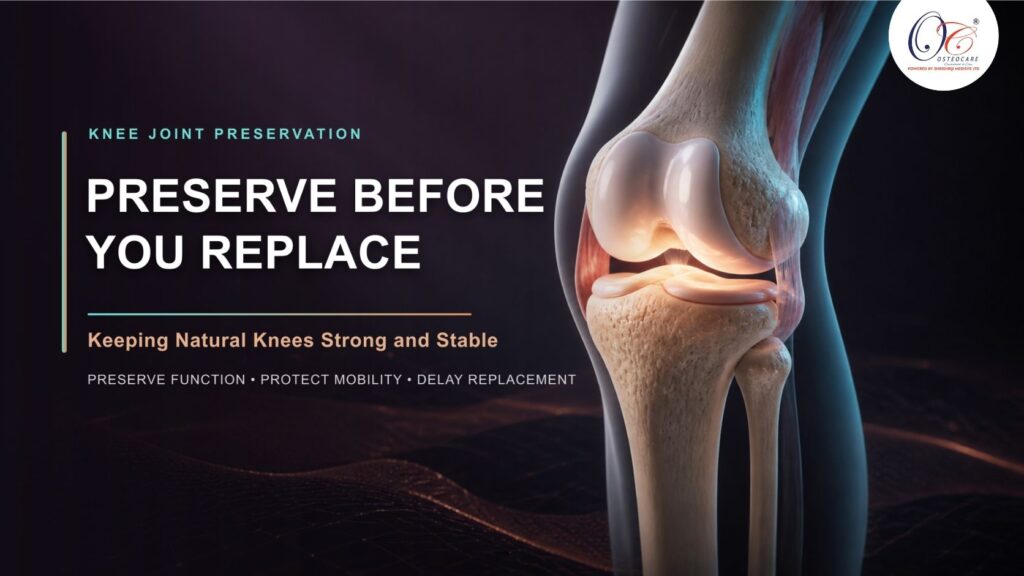
In modern orthopaedics, Knee Joint Preservation has become a crucial concept for maintaining joint function and delaying or avoiding total joint replacement. Rather than waiting for complete joint deterioration, joint preservation focuses on early intervention, lifestyle modification, biologic therapy, and surgical techniques that help preserve the knee’s natural structure and function.
🔍 What is Joint Preservation? When Should It Be Done?
Joint preservation
refers to a combination of medical, surgical, and rehabilitative strategies aimed at maintaining a healthy, functioning joint for as long as possible. It’s a proactive approach designed to:
- Prevent or slow down cartilage degeneration
- Address mechanical joint issues
- Manage pain without resorting to joint replacement
✅ When is Knee Joint Preservation Recommended?
- Early to mid-stage osteoarthritis or cartilage damage
- Meniscus or ligament injuries causing altered biomechanics
- Joint malalignment (e.g., varus or valgus knees)
- Post-traumatic conditions where the joint can still be restored
- Athletes or younger patients who want to maintain high activity levels
👥 Who Might Benefit from Knee Preservation Techniques?
Knee joint preservation can be life-changing for a variety of individuals, including:
- Young and active patients not ideal candidates for knee replacement
- Athletes recovering from meniscal or ligament injuries
- People with early cartilage degeneration or mild arthritis
- Patients with joint malalignment causing uneven load distribution
- Individuals wishing to avoid or delay total knee replacement
💊 Non-Surgical Procedures for Knee Preservation
Surgery isn’t always the first step. A combination of conservative and biologic therapies can significantly improve knee health and slow degeneration.
🔹 Common Non-Surgical Options:
- Physiotherapy & Exercise Therapy:
- Muscle strengthening
- Joint stabilization
- Proprioception training
- Weight Management: Reduces pressure on the knee joint and slows arthritis progression.
- Orthotics & Bracing: Helps in offloading damaged compartments and improving gait.
- Injections & Biologic Therapies:
- Platelet-Rich Plasma (PRP)
- Hyaluronic Acid (HA)
- Bone Marrow Aspirate Concentrate (BMAC)
- Pharmacological Management:
- NSAIDs for inflammation control
- Nutraceuticals like glucosamine, chondroitin, omega-3s
🩺 Surgical Procedures for Knee Preservation
When non-invasive methods are insufficient, minimally invasive surgical procedures can help restore joint balance and functionality while preserving natural structures.
🔹 Common Surgical Options:
- High Tibial Osteotomy (HTO): This surgery changes the alignment of the shinbone (tibia). It is used to shift weight away from a damaged part of the knee, often for those with varus (bow-legged) alignment and inner knee arthritis.
- Distal Femoral Osteotomy (DFO): Similar to HTO, but it realigns the thighbone (femur). This is typically done for valgus (knock-kneed) alignment.
- Meniscus Repair: Suturing torn meniscus tissue back together to preserves shock absorption function, avoiding long-term damage.
- Cartilage Restoration Techniques:
- Microfracture: Creating small holes in the bone to stimulate new cartilage growth. Effective for small cartilage defects.
- Autologous Chondrocyte Implantation (ACI): Healthy cartilage cells are taken from the patient, grown in a lab, and then implanted into the damaged area. A more complicated procedure, used for larger cartilage defects.
- Osteochondral Autograft/Allograft Transfer (OATS): Healthy cartilage and bone plugs are taken from a non-weight-bearing area (autograft) or a donor (allograft) and transferred to the damaged area. This is for focal, full thickness cartilage defects.
- Ligament Reconstruction (ACL/PCL): Replaces a torn anterior cruciate ligament (ACL) or posterior cruciate ligament (PCL) with a graft (tissue from the patient or a donor). Prevents secondary degeneration due to instability.
These procedures are often performed in younger, active patients to maintain knee mobility and delay progression to Osteoarthritis.
📊 Factors Involved in Knee Joint Preservation
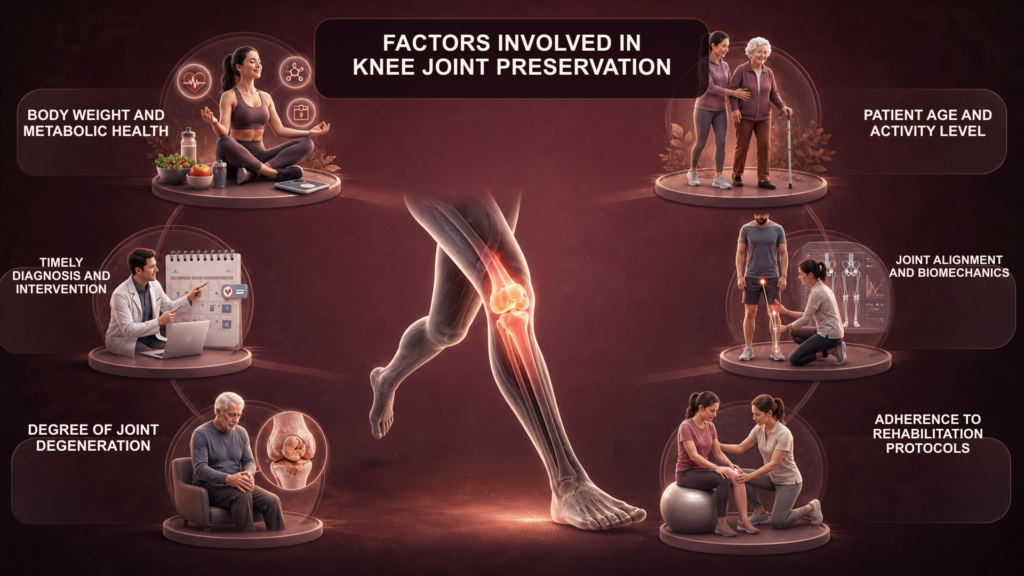
Effective joint preservation is not just about one procedure—it’s a combination of multiple factors working synergistically.
💡 Conclusion: Early Action Can Save Your Knee
Knee joint preservation is a forward-thinking strategy that goes beyond pain relief—it’s about protecting natural anatomy, restoring function, and maintaining quality of life. Whether you’re a young athlete, an active adult, or someone in the early stages of arthritis, preserving your knee now could help you stay mobile, independent, and pain-free for years to come.
👉 Remember: The sooner you act, the more joint function you can save.