

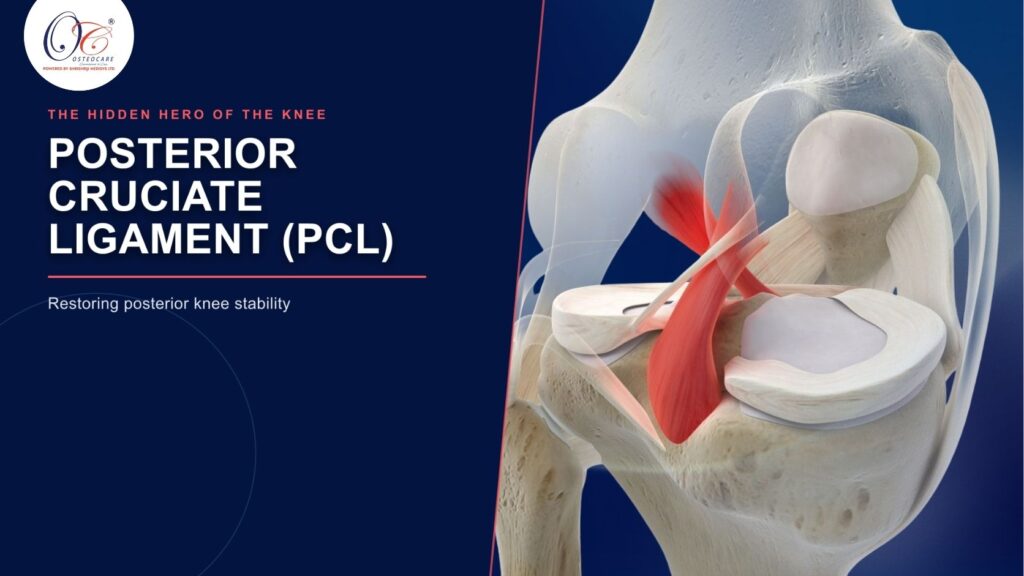
When people talk about knee ligament injuries, the Anterior Cruciate Ligament (ACL) often takes center stage. But there’s another unsung hero that plays a vital role in knee stability—the Posterior Cruciate Ligament (PCL).
While PCL injuries are less common, they can be equally debilitating. And in severe or chronic cases, PCL reconstruction surgery becomes the path to restoring knee function. 🧠 What Exactly Does the PCL Do?
Think of the PCL as the rear seatbelt of your knee. It prevents your shinbone (tibia) from sliding too far backward under your thigh bone (femur) — especially when your knee is bent.
If left untreated, PCL injuries can lead to:
- Chronic knee instability
- Accelerated cartilage wear
- Meniscus damage
- Early onset osteoarthritis
Biomechanics
- Tensile strength: ∼ 1600 to 2000 Newtons (N) (Range: 1500–2100 N depending on age, specimen, and testing method)
- Responsible for controlling 95% of posterior tibial displacement.
🧪 Classification: How Bad Is It?
PCL tears are graded based on how far the tibia slides backward:
| Grade | Description | Posterior Translation |
|---|---|---|
| I | Partial tear | 1–5 mm |
| II | Complete isolated tear | 6–10 mm |
| III | Combined injuries (with ACL or PLC) | >10 mm |
🕵️♂️ Spotting the Signs: Diagnosis & Tests
👂 Symptoms
- Vague posterior knee pain
- Mild swelling
- Feeling of instability (more with combined injuries)
🧑⚕️ Clinical Tests
- Posterior Sag Sign: Tibia drops back when knee is bent
- Posterior Drawer Test: Best test — performed at 90°
- Quadriceps Active Test: Tibia shifts forward when you contract quads
- Dial Test: Checks for combined PCL + posterolateral corner (PLC) injuries
- Varus/Valgus Stress Test: Laxity at full extension may hint at PCL involvement
🖼 Imaging
- X-ray: Check for bone avulsions and posterior sag
- Stress Views: Kneeling view is gaining popularity
- MRI: The gold standard — visualizes ligament tears and any combined injuries
📊 Surgical Techniques for PCL Reconstruction:
| Technique | Approach | Graft Passage | Advantages | Disadvantages / Risks | Best Use Case |
|---|---|---|---|---|---|
| Transtibial Technique | Anterior (front of knee) | Through tibial tunnel to femur | – Familiar to surgeons- Less invasive- Avoids posterior dissection | – Risk of popliteal artery injury– Sharp graft bend (“killer turn”) | Acute cases with good tunnel control |
| Tibial Inlay Technique | Posterior (back of tibia exposed) | Direct posterior fixation | – Avoids graft bend- Strong fixation- Protects graft integrity | – Technically more demanding- Requires posterior exposure | Chronic cases or revision surgeries |
| Single-Bundle | Either transtibial or inlay | One graft for AL bundle | – Simpler- Shorter surgical time- Good for isolated PCL tears | – May not restore full rotational stability | Low-demand patients or isolated PCL tears |
| Double-Bundle | Usually inlay with dual tunnels | Separate grafts for AL and PM | – Closer to natural anatomy- better knee kinematics and stability | – Technically complex- Longer surgical time | High-demand athletes or multi-ligament injuries |
Postoperative Rehabilitation After PCL Reconstruction
| Phase | Timeline | Goals | Activities & Precautions |
|---|---|---|---|
| Phase 1: Protection | 0 – 4 weeks | – Protect graft- Minimize swelling- Prevent posterior sag | – Knee immobilized in extension– Partial weight-bearing with crutches- Early passive ROM in prone position- Avoid active/resisted hamstring exercises |
| Phase 2: Mobilization | 4 – 8 weeks | – Regain motion- Begin quadriceps activation | – Gradually increase range of motion (especially flexion)- Begin quadriceps isometrics– No hamstring curls |
| Phase 3: Strengthening | 8 – 16 weeks | – Improve muscular strength- Begin functional training | – Start closed-chain quadriceps exercises– Light stationary cycling– Avoid resisted hamstring work |
| Phase 4: Advanced Training | 4 – 6 months | – Restore full ROM- Improve neuromuscular control- Build endurance | – Introduce leg press, balance training– Begin core strengthening– Gradual hamstring reactivation under supervision |
| Phase 5: Return to Sport | 6 – 9+ months | – Full functional recovery- Sport-specific training | – Agility drills, plyometrics, controlled sports drills– Clearance with functional tests and physician approval |
✅ In a Nutshell
The PCL may be the “silent stabilizer”, but its role in knee function is critical. With advanced surgical options and smart rehab strategies, most patients can regain strength and stability. Early diagnosis, expert care, and commitment to rehab make all the difference. Don’t ignore the PCL — respect it, repair it, and recover stronger. 💪