

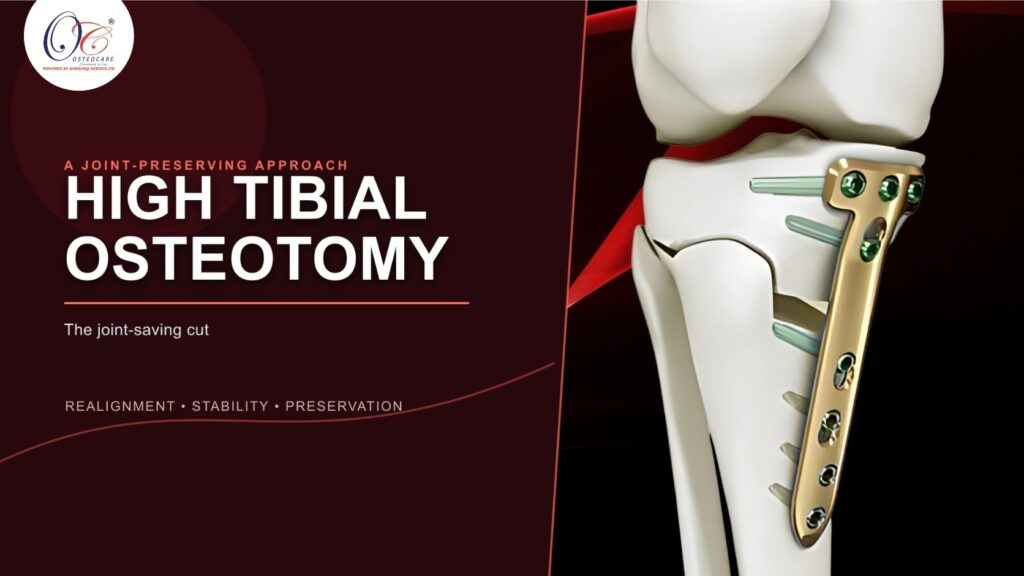
High Tibial Osteotomy (HTO) is a biomechanically intelligent surgical procedure aimed at correcting knee alignment and offloading the diseased medial compartment of the joint. For decades, HTO has stood as a joint-preserving alternative to total knee arthroplasty (TKA), particularly in younger, active patients with isolated uni-compartmental osteoarthritis and varus deformity.
While TKA continues to evolve, HTO is quietly making a comeback — powered by better understanding of knee biomechanics, advanced imaging, and precise fixation systems.
The Concept: Biomechanics Over Replacement
In a varus-aligned knee, the medial compartment bears a disproportionately higher load (up to 60–80% of total knee force). Over time, this leads to cartilage breakdown, subchondral bone sclerosis, and degenerative changes.
HTO addresses the mechanical root of this issue. By creating a controlled osteotomy in the proximal tibia and realigning the mechanical axis towards the lateral (healthier) compartment, the surgeon can:
- Unload the arthritic zone
- Reduce pain and inflammation
- Improve gait dynamics
- Delay or eliminate the need for knee replacement
Indications for HTO
HTO is ideal for:
- Medial compartment osteoarthritis (Kellgren-Lawrence grade I–III)
- Varus deformity between 5° to 15°
- Patients under 60 years with high activity levels
- Good knee ROM, no or minimal lateral compartment damage
- BMI < 30 (ideally)
It’s often recommended in patients who are “too young” for TKA but too symptomatic to continue conservative care.
Types of High Tibial Osteotomy
There are two main techniques for performing HTO:
I. Medial Opening Wedge HTO (MOWHTO)
- Type: Bone-Sparing Expansion Osteotomy
- Definition: A medial tibial cut with controlled opening, filled with graft/plate, redistributing load laterally while preserving bone stock.
II. Lateral Closing Wedge HTO (LCWHTO)
- Type: Bone-Removal Reduction Osteotomy
- Definition: A lateral wedge resection followed by gap closure, shortening the tibia to shift weight-bearing alignment.
1. Surgical Technique Comparison
| Aspect | Medial Opening Wedge HTO (MOWHTO) | Lateral Closing Wedge HTO (LCWHTO) |
|---|---|---|
| Approach | Medial side of the tibia | Lateral side of the tibia |
| Osteotomy Cut | Incomplete cut, leaving a lateral hinge (1 cm below joint line) | Complete wedge removal from the lateral cortex |
| Correction Mechanism | Wedge is opened medially, filled with bone graft/synthetic spacer | Wedge is closed, shortening the tibia |
| Fixation | Locking plates | Staples, screws, or plate fixation |
| Bone Graft Needed? | Often required (autograft/allograft/synthetic) | Not required (bone is removed) |
| Hinge Integrity | Critical (lateral hinge must remain intact) | No hinge concern (full cut made) |
2. Advantages & Disadvantages
| Factor | MOWHTO | LCWHTO |
|---|---|---|
| ✔ Advantages | – Easier to adjust correction intraoperatively- Preserves bone stock- Lower risk of peroneal nerve injury- Better for large corrections (>10°) | – No need for bone graft- Faster bone healing (direct contact)- Historically more biomechanically stable |
| ✖ Disadvantages | – Risk of lateral hinge fracture- Requires bone graft- Slightly higher non-union risk | – Peroneal nerve injury risk- More difficult to adjust correction- Shortens the tibia slightly |
3. Clinical Outcomes & Complications
| Outcome | MOWHTO | LCWHTO |
|---|---|---|
| Union Rate | ~90-95% (slower due to graft incorporation) | ~95-98% (faster due to direct bone contact) |
| Complications | – Lateral hinge fracture (5-10%)- Non-union (3-5%)- Plate irritation (may require removal) | – Peroneal nerve palsy (5-15%)- Overcorrection risk- Patella baja (due to shortening) |
| Functional Recovery | – Slighter slower initial recovery (due to graft healing)- Comparable long-term outcomes | – Faster early weight-bearing- Similar long-term results |
Today, MOWHTO is highly preferred globally due to its adaptability, ease, and favourable healing characteristics when paired with modern fixation plates.
Role of Navigation & Pre-Op Planning
Digital planning tools
and navigation systems enhance accuracy in:
- Determining the degree of correction (usually aiming for 3–5° valgus mechanical axis)
- Predicting postoperative limb alignment
- Avoiding overcorrection or undercorrection, which can cause new joint problems
Surgeons now use long-leg standing radiographs, CT scans, and mechanical axis software to guide their correction strategy.
Post-Operative Protocol & Rehabilitation
- Initial partial weight-bearing (2–4 weeks), progressing to full weight-bearing by 6–8 weeks depending on bone healing.
- Range of motion (ROM) exercises start early to avoid stiffness.
- Return to sports or heavy labour: usually within 4 to 6 months.
- Regular X-rays are used to monitor osteotomy site healing.
Clinical Outcomes
Several long-term studies report:
- 10–15 years delay in knee replacement following HTO
- Improved pain scores, function like WOMAC (Western Ontario and McMaster Universities Osteoarthritis Index), KOOS (Knee injury and Osteoarthritis Outcome Score), and return to sports
- Survival rates of 85–90% at 10 years, depending on alignment accuracy
HTO also opens doors for biologic procedures like cartilage restoration or meniscus transplantation when performed in combination.
Complications and Considerations
While HTO is generally safe, it’s not free from risk. Common concerns include:
- Delayed union or non-union (especially with large gaps)
- Overcorrection or Undercorrection
- Infection or neurovascular injury
- Implant-related irritation (resolved by implant removal later)
These can be significantly minimized by accurate pre-op planning, surgical expertise, and robust fixation.
Conclusion
High Tibial Osteotomy is more than a mechanical cut — it’s a strategic orthopaedic intervention. For the right patient, at the right time, using the right technique and implant, HTO delivers life-changing outcomes.
As modern orthopaedics moves toward preservation over prosthesis, HTO stands tall as a clinically proven, biologically respectful, and biomechanically rational approach to knee osteoarthritis. HTO is evolving beyond a bridging procedure — it’s becoming a cornerstone of personalized knee preservation.
References
Open Wedge High Tibial Osteotomy Principles and Techniques BY MICHAEL SCHÜTZ, KENICHI GOSHIMA, TAKESSHI SAWAGUCHI, AND YE HUANG: https://www.aofoundation.org/trauma/about-aotrauma/blog/2023_04-blog-open-wedge-high-tibia-osteotomy
High Tibial Osteotomy: https://www.orthobullets.com/recon/3135/high-tibial-osteotomy
Survivorship of high tibial osteotomy: comparison between opening and closing wedge osteotomy: https://aoj.amegroups.org/article/view/4404/html